How to Hire a Tile Installer in Minnesota: 9 Questions That Reveal Who Actually Knows Waterproofing
Anyone can show you a beautiful finished shower. The installer you want can explain what is behind it — by name, in numbers, without hesitating. These nine questions do that sorting in one conversation, and we will tell you exactly what a good answer sounds like, including the honest answer about our own licensing setup.
The uncomfortable truth about hiring for tile: the product you are buying is invisible. By the time you can judge the work — when a bad pan starts staining the ceiling below — the installer is paid and gone. So the decision has to happen when the truth is available: the conversation before the contract. Ask these nine questions, and the difference between an installer who builds waterproof showers and one who builds good-looking ones becomes obvious within minutes.
We install tile and bathrooms across Ramsey, Anoka County, and the Twin Cities, and we are giving you the questions we would want asked of us — including, at the end, the licensing question, where we will tell you plainly how our own business is structured. Judge everyone, us included, by the same standard.
The 9 questions
1. "What waterproofing system do you use — by name?"
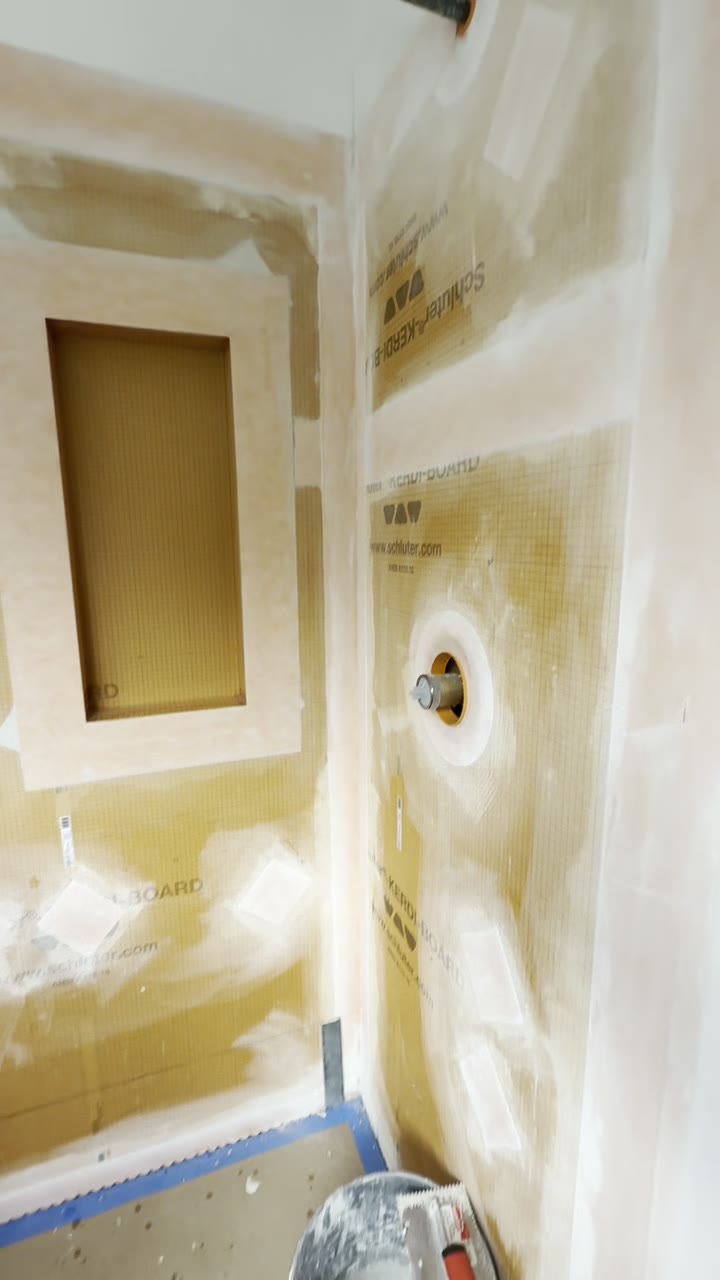
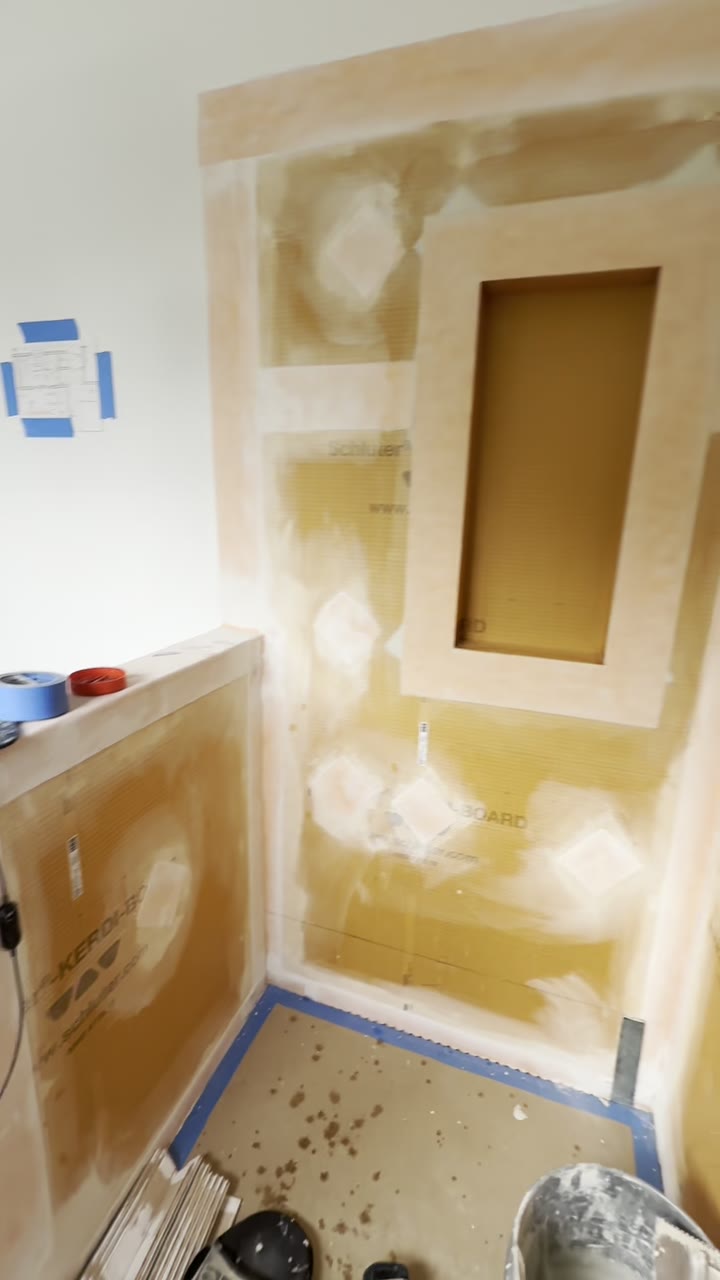
Good answer: a named system and a reason — "Schluter-Kerdi with the matching drain and corners," or "a liquid membrane at full specified thickness over cement board," matched to your shower (steam changes the answer entirely). Our comparison of shower waterproofing membranes gives you the vocabulary. Bad answer: "We waterproof everything, don't worry," or the name of a paint-store coating. Waterproofing is a system, not a verb.
2. "Do you flood test the pan before tile?"
Good answer: "Yes — plug the drain, fill to the curb, mark the level, 24 hours." No hesitation, no conditions. Bad answer: "Our showers never leak," "the membrane warranty covers it," or a blank look. Confidence is not a test. We wrote a whole guide to the flood test because this one question predicts more than any other.
3. "What mortar coverage do you get — and how do you know?"
Good answer: numbers — 80% coverage minimum on dry floors, 95% in showers and under large format, achieved with the right trowel, directional combing, and back-buttering big tile — plus the occasional lifted tile to prove it. Bad answer: "Plenty — we use lots of mud," or spot-bonding defended as a technique. Dabs of mortar under corners is how tiles crack and drum hollow.
4. "Where do the movement joints go?"
Good answer: soft joints — silicone or a matching sealant, never hard grout — at every change of plane (wall-to-wall corners, wall-to-floor, around the tub deck), at the perimeter, and in long floor runs at the intervals the standards call for. Tile fields move with temperature, humidity, and the house itself; something has to absorb it. Bad answer: "We grout everything solid — it looks cleaner." Grouted corners crack, and the crack is the movement making its own joint, through your grout line.
5. "Who pulls the permits, and how do you work with the general contractor?"
Good answer: a clear structure, stated before you ask twice — either the installer is the licensed remodeler on your contract and pulls the permits, or (very common, and legitimate) the installer works as a specialty subcontractor under a licensed general contractor who holds the permits, and can tell you exactly who that is on your project. Bad answer: "Permits? You don't need permits for tile," offered as a way to save you money. Sometimes a like-for-like tile swap truly needs none; a shower rebuild with plumbing moves is a different matter, and the person who waves it off is transferring the risk to you. More on the Minnesota specifics below.
6. "Are you insured — can I see the certificate?"
Good answer: "Yes — I'll send the certificate," and it arrives: general liability from a named carrier, current dates, workers' compensation if there are employees. Bad answer: offense, delay, or "I've never had a claim in twenty years." Maybe true — and irrelevant. Insurance is not about his history; it is about your house on the one bad day. A professional treats the request as routine because it is.
7. "Will the scope be written — line by line?"
Good answer: a written scope naming the waterproofing system, tile and pattern, prep included, features (niche, bench) priced, exclusions listed, payment schedule tied to milestones, and how change orders are priced. Bad answer: a single number on a text message. Every dispute we have ever heard about started life as a vague scope that two people remembered differently.
8. "What is the realistic timeline — and what does it depend on?"
Good answer: a range with the dependencies named — cure times, the 24-hour flood test, inspections, glass and material lead times — and a start date he will commit to. A full tile shower is days of setting plus days of curing and testing that cannot be compressed. Bad answer: "Two days, in and out" for a custom shower. Speed is a scope decision made at your expense, in the layers you cannot see.
9. "Can I see in-progress photos — and what is your labor warranty?"
Good answer: photos of pans, membrane, and coverage checks from real jobs — the ugly middle stages — plus a written workmanship warranty (one year is a common baseline) with the business's name on it, backed by manufacturer system warranties where a full system was used. Bad answer: a gallery of nothing but finished rooms and "just call me if there's a problem." The finished room is the one thing every installer, good or bad, can show you.

The Minnesota part, explained honestly — including us
Minnesota licenses residential building contractors and remodelers through the Minnesota Department of Labor and Industry, and you can verify any license on the DLI's contractor lookup before you sign anything. The structure that matters for a homeowner is this: a multi-trade remodel contracted directly with you generally runs under a licensed residential remodeler or general contractor, who holds the license, pulls the permits, and carries the overall responsibility for the project. Specialty trades — tile setters among them — very commonly work under that contractor as subcontractors. That is a normal, legitimate structure, not a workaround.
So here is our own answer to question 5, in the open: Northline Renovations LLC is a registered, active Minnesota LLC — and we are not a licensed Minnesota general contractor. We are tile, bathroom, and flooring installers — seven years in the trade — and we install under licensed general contractors, which is exactly the structure described above. What that means for a homeowner: on a project run by a GC, our scope, warranty, and work sit inside that contractor's licensed project; when you talk to us about tile work, we will tell you plainly which structure your project needs and who holds what. We would rather lose a job to that honesty than win one by letting you assume something that is not true. Any installer who cannot state his structure this clearly — whichever structure it is — has not answered the question.
How to use the answers
Score the conversation, not the charisma. The installer you want answers in names, numbers, and documents: a system by name, 24 hours, 95%, a certificate, a written scope, in-progress photos, a warranty on paper. The one to avoid answers in reassurance. If you are gathering numbers, our Twin Cities tile cost guide will help you read the quotes that follow, and the remodel calculator gives you a ballpark to measure them against.
Ready to ask us the nine? Send us your project or call 763-260-4117 — we will answer every one, in writing, before we ask you to sign anything.
Thinking about this project?
Send us a few details and photos — we'll reply with a free, no-pressure estimate.
Common questions
Does a tile installer need a license in Minnesota?
It depends on the role. Minnesota licenses residential remodelers and general contractors through the Department of Labor and Industry, and a company contracting directly with a homeowner for a multi-trade remodel generally needs that license. A specialty installer like a tile setter commonly works as a subcontractor under a licensed general contractor, who holds the license and pulls the permits. Ask whoever you hire which structure your project will use — and verify licenses on the DLI lookup.
What waterproofing questions should I ask a tile installer?
Ask which membrane system they use by name, how corners and penetrations are sealed, what drain it pairs with, and whether they flood test the pan for 24 hours before tile. Good answers name a system and a test. Vague answers — 'we waterproof everything, don't worry' — are the single most reliable predictor of a leaking shower.
Should a tile installer carry insurance?
Yes — general liability at minimum, and workers' compensation if they have employees. Ask for a certificate of insurance, not just a yes. A certificate names the carrier, the policy, and the dates, and a professional will send it without being offended. If your installer works under a general contractor, that contractor's insurance structure matters too — ask how it fits together.
What kind of warranty should tile work come with?
At minimum, a written labor warranty — one year is a common baseline for workmanship, and the waterproofing and setting-material manufacturers add their own product and system warranties when a full system is installed as specified. Get the labor warranty in writing, in the contract, with a name and a business behind it. A verbal 'call me if anything happens' is not a warranty.
Why do installers show only finished photos?
Finished photos are the easy part — grout hides everything. In-progress photos of waterproofing, pans, and mortar coverage show the work that actually determines whether the shower lasts. An installer who documents the hidden stages is showing you a process, and process is what you are really hiring.